| Availability: | |||||||||
|---|---|---|---|---|---|---|---|---|---|
| Quantity: | |||||||||
| JTYPEI® NA is a natural, unfilled PEI sheet developed for machined components requiring inherent flame resistance, low smoke generation, electrical insulation, dimensional stability and reliable performance at elevated temperatures. It is suitable for selected aircraft interior systems, aerospace electrical equipment, automotive electronics, electric vehicle battery systems, sensors, lighting systems and high-temperature insulating components. Sheets are available in thicknesses from 1 to 100 mm, with cut-to-size supply, controlled annealing and precision CNC machining available. Performance and regulatory compliance must be confirmed according to the selected resin grade, sheet thickness, finished component design and applicable industry standard. | |||||||||
JTYPEI® NA is a natural, unfilled polyetherimide sheet for machined aerospace and automotive components requiring a combination of inherent flame resistance, low smoke generation, electrical insulation, mechanical strength and long-term heat resistance.
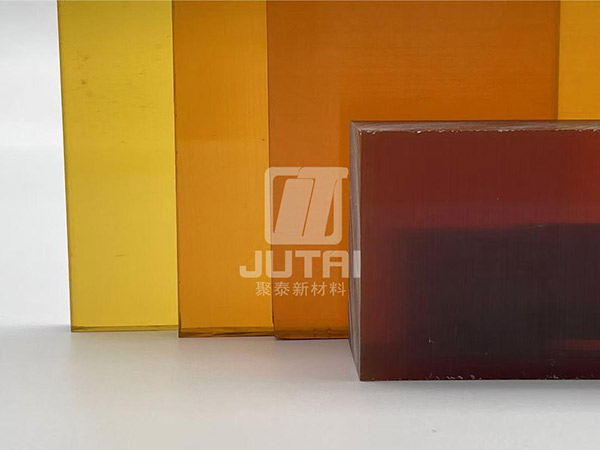
The material is normally translucent amber and can be manufactured from SABIC ULTEM™ 1000 resin according to customer requirements.
Unlike conventional engineering plastics that may require additional flame-retardant additives, PEI offers inherent flame resistance in standard unfilled formulations. This makes it useful for electrical, electronic and interior transportation components where heat resistance, weight reduction and fire performance must be considered together.
JTYPEI® NA sheet is intended for machining flat, structural and insulating components. Suitability must be evaluated according to the final component geometry, material thickness, mechanical load, operating temperature, chemical exposure and applicable fire-safety standard.
ULTEM™ is a trademark of SABIC.
Natural PEI is inherently flame-resistant and can provide UL94 V-0 performance depending on the selected resin grade, material thickness and test conditions.
Its flame resistance is achieved without relying on conventional halogenated flame-retardant additives in many standard formulations.
The flame rating of the raw resin should not automatically be treated as certification of the extruded sheet or finished machined component.
PEI produces relatively low smoke when compared with many conventional thermoplastics.
This property is particularly valuable for enclosed transportation environments where smoke generation and visibility during a fire event are important design considerations.
Actual smoke-density and toxicity performance must be confirmed through the applicable material or finished-component test.
JTYPEI® NA can provide long-term service at temperatures up to approximately 170°C, depending on mechanical load, chemical exposure, pressure and component design.
Its glass transition temperature is approximately 217°C, enabling PEI to maintain useful strength, stiffness and dimensional stability at elevated temperatures.
The glass transition temperature must not be treated as the recommended continuous operating temperature of a finished part.
Natural unfilled PEI provides high volume resistivity, good dielectric strength and stable electrical performance across a wide temperature and frequency range.
It is suitable for components that combine mechanical support with electrical separation, including insulating plates, spacers, terminal supports, sensor components and battery-system insulation.
PEI combines low moisture absorption, good creep resistance and relatively low thermal expansion.
These properties help machined components maintain dimensional accuracy during assembly, thermal cycling and long-term operation.
Controlled annealing can be provided for parts requiring tight tolerances or extensive material removal.
PEI has a substantially lower density than metals and can help reduce component weight in suitable aerospace and automotive applications.
It may also eliminate secondary corrosion protection and electrical insulation treatments required by some metal components.
JTYPEI® NA PEI sheet can be evaluated for machining selected non-primary structural, electrical and interior aerospace components.
Potential applications include:
• Interior equipment brackets
• Electrical insulating panels
• Seat-system spacers and supports
• Cabin equipment covers
• Lightweight mounting plates
• Cable-management components
• Equipment interface plates
• Service-equipment components
PEI is especially useful where low weight, flame resistance, electrical insulation and dimensional stability are required together.
PEI sheet can be machined into:
• Electrical insulating plates
• Connector mounting components
• Terminal supports
• Sensor mounting plates
• High-temperature spacers
• Electronic equipment supports
• Cable guides and clamps
• Avionics equipment fixtures
JTYPEI® NA may also be used for:
• Aerospace assembly fixtures
• Electrical test fixtures
• High-temperature positioning tools
• Insulating supports
• Inspection-equipment components
• Precision alignment plates
Use of PEI in an aerospace application does not automatically mean that every PEI sheet or machined component complies with FAR/CS 25.853, OSU heat-release, smoke-density, toxicity or an aircraft OEM specification.
Required test reports and material documentation must be confirmed before the product is specified for a regulated aerospace application.
Natural PEI sheet can be machined into electrical insulating components used around:
• Battery modules
• Busbar systems
• Charging equipment
• Power-control units
• Electric motors
• High-voltage connectors
• Sensor assemblies
• Electrical distribution equipment
Its electrical insulation, flame resistance and dimensional stability make it useful for components exposed to elevated temperatures and electrical loads.
Required creepage distance, clearance, dielectric strength, voltage, temperature and environmental exposure must be evaluated in the final design.
Potential components include:
• Battery insulation plates
• Module spacers
• Terminal barriers
• Sensor supports
• Cable-routing components
• Battery equipment fixtures
• Thermal-management system supports
• Electrical separation components
PEI should not be represented as a thermal-runaway barrier or certified battery fire-protection material unless the finished construction has been tested according to the applicable standard.
PEI sheet can be machined into:
• Sensor mounting plates
• Electronic control-system supports
• Insulating housings and covers
• Connector components
• Relay and switch supports
• Precision positioning components
• High-temperature electrical fixtures
The dimensional stability and heat resistance of PEI make it suitable for selected lighting-system and optical-equipment components, including:
• Lamp-support components
• Reflector mounting parts
• Sensor and camera supports
• Insulating spacers
• Precision adjustment components
PEI may be considered for selected components exposed to elevated temperatures, automotive fluids and electrical requirements.
Chemical compatibility must be confirmed for the actual fluid, concentration, temperature, pressure, exposure time and mechanical stress.
Application Requirement | JTYPEI® NA Advantage | Design Verification Required |
|---|---|---|
Flame resistance | Inherent flame resistance in standard unfilled PEI formulations | Resin grade, thickness and finished-part test |
Low smoke | Relatively low smoke generation | Applicable smoke and toxicity standard |
Elevated temperature | Long-term service temperature up to approximately 170°C | Load, duration, environment and safety factor |
Electrical insulation | High volume resistivity and dielectric strength | Voltage, frequency, creepage and clearance |
Dimensional accuracy | Low moisture absorption and good dimensional stability | Tolerance, thermal expansion and annealing |
Weight reduction | Lower density than metals | Mechanical load and component geometry |
Automotive-fluid exposure | Resistance to many oils, fuels and hydrocarbons | Actual fluid, temperature and exposure time |
Precision machining | Suitable for CNC milling, drilling and finishing | Wall thickness, machining heat and internal stress |
• Inherent flame resistance
• Electrical insulation
• Natural translucent amber appearance
• Low smoke generation
• Balanced strength and toughness
• Precision CNC machining
• Complex component geometry
• A smoother machined surface
• Lower tool wear than reinforced PEI
• Higher stiffness
• Lower thermal expansion
• Improved dimensional stability
• Greater resistance to deformation
• Higher structural load capability
• Better stability during thermal cycling
JTYPEI® GF30 contains 30% glass-fiber reinforcement and can be manufactured using SABIC ULTEM™ 2300 resin where required.
Glass-fiber reinforcement increases tool wear and may produce a less uniform machined surface than natural PEI.
• Higher continuous operating temperature
• Better chemical resistance
• Better hydrolysis and steam resistance
• Higher fatigue resistance
• Better wear performance
• Performance in more demanding mechanical environments
• Repeated steam sterilization
• Higher impact resistance
• Improved hydrolysis resistance
• Medical equipment applications
• High-temperature electrical performance
• Strong chemical resistance
• Lower moisture absorption
• Higher-volume molded components
Final material selection must consider temperature, mechanical load, chemical exposure, electrical requirements, flame standard, component geometry and expected service life.
Property | Test Method | Unit | Typical Value |
|---|---|---|---|
Color | Visual | — | Translucent amber |
Density | ISO 1183-1 | g/cm³ | 1.28 |
Glass Transition Temperature | ISO 11357-3 | °C | 217 |
Long-Term Service Temperature | UL 746B | °C | 170 |
Heat Deflection Temperature at 1.80 MPa | ISO 75-2 | °C | ≥200 |
Flammability | UL 94 | — | V-0 |
Volume Resistivity | IEC 62631-3-1 | Ω·cm | ≥10⊃1;⁵ |
Dielectric Strength | IEC 60243-1 | kV/mm | ≥26 |
These values are typical reference values and are not guaranteed specification limits.
Actual properties may vary according to the selected resin grade, sheet thickness, extrusion or compression-molding process, annealing condition, sample preparation and test method.
Flame, smoke, toxicity and transportation-industry compliance must be confirmed for the selected material thickness and finished component.
For the complete Technical Data Sheet and full sheet-size table, please visit:
JTYPEI® NA PEI sheets are available in thicknesses from 1 to 100 mm.
Common sheet formats include:
• Width: 620 mm
• Length: 1,000 mm
• Length: 2,000 mm
• Length: 3,000 mm
Customized thicknesses, widths and lengths can be evaluated according to quantity, resin grade and manufacturing requirements.
Available services include:
• Cut-to-size PEI sheets
• Controlled annealing
• CNC milling
• CNC drilling
• Pocket machining
• Surface finishing
• Dimensional inspection
• Component assembly
• Custom packaging
• Worldwide delivery
Stock availability should be confirmed according to thickness, width, length, resin grade and required quantity.
Use sharp carbide or tungsten-carbide tools suitable for machining aluminum and engineering plastics.
Dull tools may generate excessive heat, poor surface quality and dimensional instability.
Use stable and evenly distributed clamping pressure.
Excessive clamping force may deform the sheet and cause dimensional changes after the part is released.
Adequate cooling should be used to control cutting temperature and prevent material burning, tool adhesion and internal stress.
Water-soluble cutting fluids may be used where appropriate, subject to final cleaning and application requirements.
Avoid sharp internal corners wherever possible.
Suitable radii help reduce stress concentration and the risk of cracking during machining, assembly and thermal cycling.
Annealing should be considered for:
• Tight-tolerance components
• Parts requiring extensive material removal
• Thin-wall components
• Parts with large differences in wall thickness
• Components used at elevated temperatures
• Components requiring several machining stages
For high-precision components, rough machining followed by intermediate annealing and final machining may improve dimensional stability.
JUTAI operates under an ISO 9001:2015 quality management system.
The following documentation can be provided where applicable:
• Technical Data Sheet
• Resin Certificate of Analysis
• Certificate of Conformity
• Material Safety Data Sheet
• RoHS documentation
• REACH documentation
• Dimensional inspection report
• Material traceability information
Customers requiring aerospace, automotive, railway, electrical or other regulated compliance should provide the exact standard, test method, material thickness and finished-component requirements before ordering.
No industry-specific certification should be assumed unless it is supported by an applicable test report or certificate.
PEI is widely used in aerospace applications because of its flame resistance, low smoke, heat resistance and low weight.
However, standard industrial PEI sheet should not automatically be represented as certified to FAR/CS 25.853, OSU heat-release, smoke-density, toxicity or an aircraft OEM specification.
Please provide the required standard so that JUTAI can review the selected resin grade, thickness and available documentation.
Natural PEI can provide UL94 V-0 performance depending on the selected resin grade, product thickness and test conditions.
The applicable resin listing or finished-sheet test report should be confirmed before the rating is included in a regulated product specification.
PEI can be used for selected battery-system insulation, spacers, supports, sensor components and electrical barriers.
Final suitability depends on voltage, operating temperature, flame requirements, component geometry, mechanical load and applicable battery-safety standard.
PEI offers resistance to many oils, fuels, hydrocarbons, alcohols and weak aqueous solutions.
Compatibility must be evaluated using the actual fluid, concentration, temperature, pressure, exposure time and mechanical stress.
JTYPEI® NA can provide long-term service at temperatures up to approximately 170°C, depending on mechanical load, chemical exposure, pressure and component design.
The final operating limit must be established for the complete application rather than temperature alone.
Natural PEI provides better machinability, balanced toughness, electrical insulation and a smoother machined surface.
PEI GF30 provides higher stiffness, lower thermal expansion and better dimensional stability under load, but it is more abrasive to machining tools.
PEI provides inherent flame resistance, electrical insulation, dimensional stability and long-term heat performance at a lower material cost than PEEK in many applications.
PEEK generally provides higher continuous-use temperature, better chemical resistance, better hydrolysis resistance and improved fatigue and wear performance.
Yes. JUTAI provides cutting, annealing, CNC milling, drilling, surface finishing and dimensional inspection according to customer drawings.
Machining capability does not by itself constitute approval of a finished component for a regulated aerospace or automotive application.
The applicable TDS, resin COA, COC, MSDS, RoHS, REACH and dimensional inspection reports can be provided where available.
Industry-specific test reports must be confirmed according to the selected material and customer standard.
Please provide:
• Required sheet thickness
• Width and length
• Quantity
• Dimensional tolerances
• Preferred resin grade
• Operating temperature
• Mechanical load
• Electrical requirements
• Chemical or fluid exposure
• Required flame or industry standard
• Machining drawing
• Required certificates
• Destination country
Please send us your component drawing, operating conditions and required industry standard.
JUTAI will evaluate whether natural PEI, PEI GF30, PEEK, PPS or another high-performance plastic is appropriate for the application.
Contact JUTAI for:
• Material selection
• PEI sheet quotations
• Stock confirmation
• Technical data sheets
• Resin certificates
• Samples
• Custom sheet cutting
• Controlled annealing
• Precision CNC machining
• Dimensional inspection
• Worldwide delivery
INQUIRY MESSAGE
Please quote JTYPEI® NA PEI Sheet:
Application: Aerospace / Automotive / Electric Vehicle / Other
Component Name: ___
Thickness: ___ mm
Width × Length: ___ mm
Quantity: ___ pcs
Required Tolerance: ___
Operating Temperature: ___
Mechanical Load: ___
Operating Voltage: ___
Chemical or Fluid Exposure: ___
Required Flame Standard: ___
Required Certificates: ___
Machining Required: Yes / No
Drawing Available: Yes / No
Destination Country: ___