| Availability: | |||||||||
|---|---|---|---|---|---|---|---|---|---|
| Quantity: | |||||||||
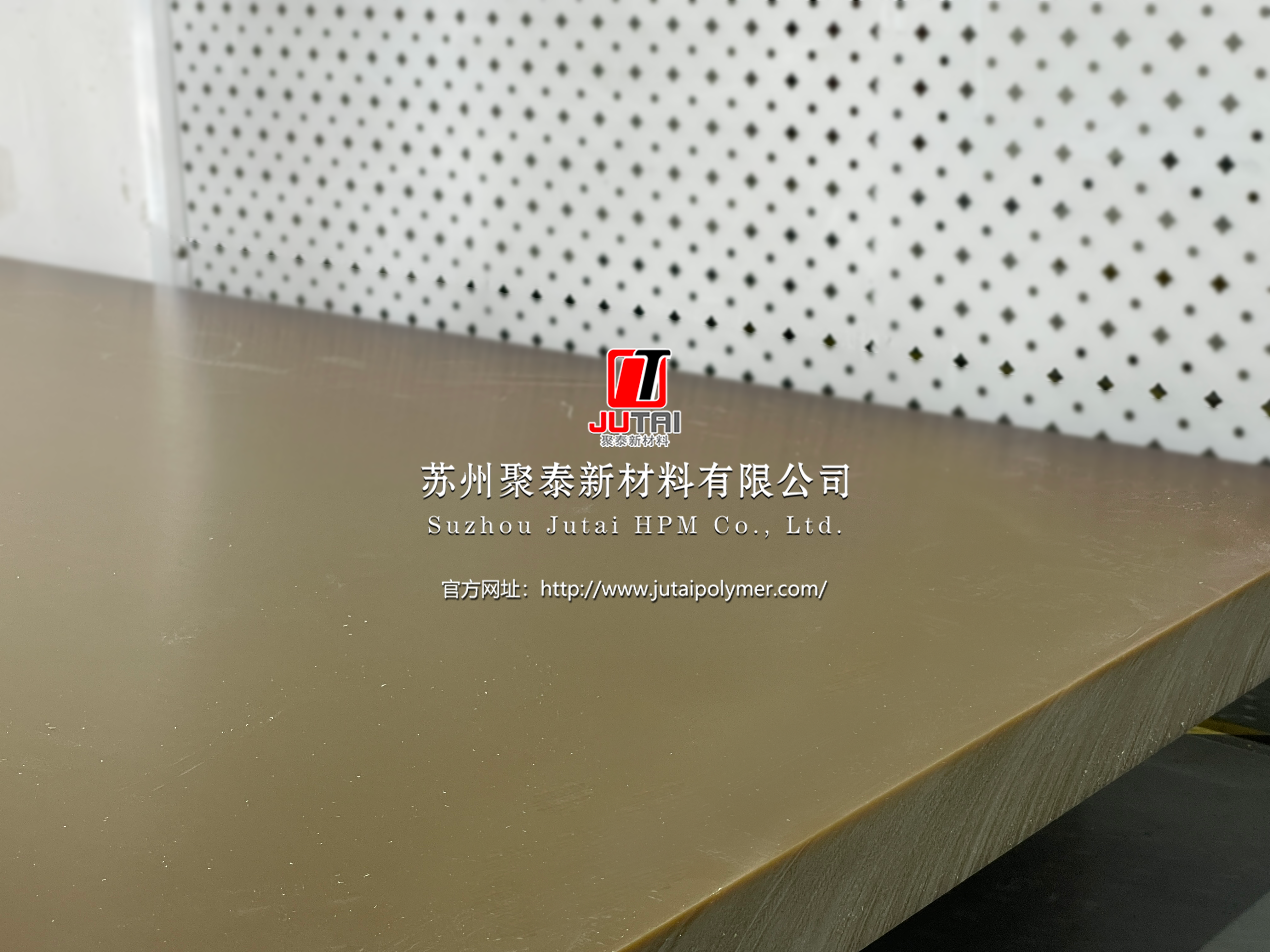
| JTYPEI® GF30 is a 30% short-glass-fiber-reinforced polyetherimide sheet developed for components requiring higher stiffness, lower thermal expansion and improved dimensional stability compared with natural unfilled PEI. Standard sheets are available in thicknesses from 5 to 100 mm, a standard width of 620 mm and lengths of 1,000 mm, 2,000 mm and 3,000 mm. SABIC ULTEM™ 2300 resin, cut-to-size plates, controlled annealing and precision CNC machining are available according to customer requirements. | |||||||||
JTYPEI® GF30 is a high-stiffness polyetherimide stock-shape sheet reinforced with 30% short glass fiber.
Compared with natural unfilled PEI, the glass-fiber reinforcement increases stiffness, reduces thermal expansion and improves resistance to deformation under mechanical load and repeated temperature changes.
JTYPEI® GF30 sheet is intended for CNC-machined plates, structural supports, equipment fixtures, electrical insulating components and precision parts requiring greater dimensional stability than natural PEI can provide.
SABIC ULTEM™ 2300 resin can be selected for customers requiring a recognized resin grade, resin traceability and supporting documentation.
ULTEM™ is a trademark of SABIC.
Item | Specification |
|---|---|
Product grade | JTYPEI® GF30 |
Material | 30% glass-fiber-reinforced PEI |
Resin option | SABIC ULTEM™ 2300 |
Product form | Sheet and cut plate |
Standard color | Olive |
Thickness range | 5–100 mm |
Standard width | 620 mm |
Standard lengths | 1,000 / 2,000 / 3,000 mm |
Cut-to-size | Available |
Annealing | Available |
CNC machining | Available |
Quality documents | TDS, resin COA, COC, MSDS, RoHS and REACH where applicable |
The 30% glass-fiber reinforcement significantly increases the stiffness of PEI.
JTYPEI® GF30 is suitable for structural plates, supports and fixtures that must resist bending or dimensional movement under mechanical load.
The allowable load for a finished component depends on operating temperature, load duration, part geometry, fiber orientation, fixing method and the required safety factor.
PEI GF30 provides lower thermal expansion than natural unfilled PEI.
This helps machined components maintain more stable dimensions during equipment start-up, heating, cooling and repeated thermal cycling.
Lower thermal expansion is particularly useful in assemblies containing metal inserts, sensors, fasteners or accurately positioned components.
The combination of glass-fiber reinforcement, low moisture absorption and good creep resistance helps components maintain stable dimensions.
For precision components requiring tight tolerances, rough machining, intermediate stress relief and final machining may be recommended.
JTYPEI® GF30 can provide reliable performance at elevated temperatures.
Long-term service temperature depends on mechanical load, chemical exposure, component thickness, fixing method, pressure and expected operating life.
The temperatures in the technical data table are material reference values and must not be treated as guaranteed operating limits for every finished component.
Standard PEI GF30 is generally an electrically insulating material.
It can be used for components that provide both structural support and electrical separation.
Electrical performance must be confirmed according to component thickness, operating voltage, frequency, moisture, temperature and the applicable electrical standard.
PEI is inherently flame-resistant in many standard formulations.
PEI GF30 may achieve UL94 V-0 performance depending on the selected resin grade, sheet thickness and test conditions.
Industry-specific flame, smoke and toxicity requirements must be verified according to the resin grade and final component.
JTYPEI® GF30 sheet can be machined into:
• Structural mounting plates
• Precision fixture plates
• Electrical insulating plates
• Equipment supports
• Sensor mounting plates
• Connector support components
• Semiconductor-equipment fixtures
• Automation-system components
• High-temperature equipment parts
• Positioning plates
• Test fixtures
• Lightweight structural brackets
• Thermal-cycling equipment components
• Custom CNC-machined parts
Final material suitability must be confirmed according to load, temperature, chemical exposure, voltage, vibration, fatigue and component geometry.
Selection Factor | JTYPEI® GF30 | JTYPEI® NA |
|---|---|---|
Reinforcement | 30% glass fiber | Unfilled |
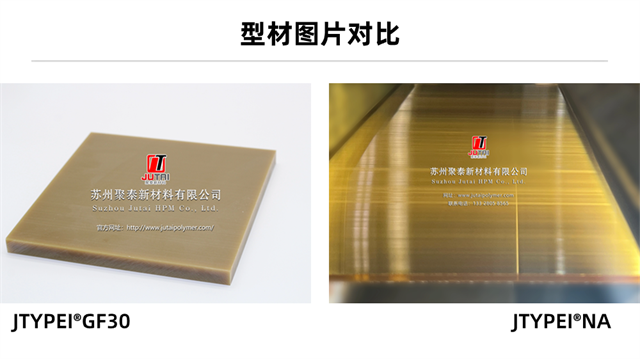
Color | Opaque olive | Translucent amber |
Stiffness | Higher | Moderate |
Thermal expansion | Lower | Higher |
Stability under load | Better | Good |
Impact toughness | Lower | Better balanced toughness |
Machinability | More abrasive to tools | Easier to machine |
Surface finish | Fiber-reinforced appearance | Smoother surface |
Best suited for | Rigid structural components | General electrical and precision parts |
Select JTYPEI® GF30 when stiffness, resistance to deformation and dimensional stability are the primary requirements.
Select JTYPEI® NA when better impact toughness, easier machining, smoother surface finish or natural amber appearance is required. JTYPEI® NA ULTEM™ 1000 PEI Sheet 1–100 mm
Glass fibers increase cutting-tool wear.
Sharp carbide, tungsten-carbide or PCD-coated tools are recommended for production machining.
Use stable support and evenly distributed clamping force.
Excessive clamping pressure can deform the sheet and affect final dimensional accuracy.
For large holes, begin with a smaller pilot hole and gradually enlarge the diameter.
Avoid excessive feed, heat accumulation and drilling with blunt tools.
Use suitable cutting parameters and adequate cooling to prevent overheating, surface burning, tool adhesion and dimensional instability.
Water-soluble cutting fluid may be used where appropriate, subject to final cleaning and application requirements.
For precision components, the recommended process is:
Cut an oversized blank.
Rough-machine the component.
Allow the component to stabilize or perform stress relief when required.
Finish-machine critical dimensions.
Inspect at a controlled temperature.
Avoid sharp internal corners, deep notches and sudden changes in wall thickness.
Use suitable internal radii and smooth transitions to reduce stress concentration.
Account for fiber orientation, thermal expansion, fixing stress and the thermal expansion difference between PEI GF30 and adjacent metal components.
JTYPEI® GF30 PEI Sheet Technical Data Sheet | |||
Property | Test Method | Unit | Typical Value |
Color | Visual | — | Olive |
Density | ISO 1183-1 | g/cm³ | 1.51 |
Tensile Strength | ISO 527-2 | MPa | ≥160 |
Tensile Modulus | ISO 527-2 | GPa | ≥7.6 |
Elongation at Break | ISO 527-2 | % | ≥3 |
Notched Charpy Impact Strength | ISO 179 | kJ/m² | ≥10 |
Flexural Strength | ISO 178 | MPa | ≥210 |
Flexural Modulus | ISO 178 | GPa | ≥5.8 |
Rockwell Hardness | ISO 2039-2 | HRM | ≥100 |
Glass Transition Temperature | ISO 11357-3 | °C | 215 |
Coefficient of Linear Thermal Expansion (20–100°C) | ISO 11359-2 | 10⁻⁶/K | ≤60 |
Long-Term Service Temperature | UL 746B | °C | 170 |
Heat Deflection Temperature | ISO 75-2 | °C | ≥210 |
Water Absorption (23°C, Water, 24 h) | ISO 62 | % | ≤0.26 |
Flame Retardancy | UL 94 | — | V-0 |
Volume Resistivity | IEC 61340-2-3 | Ω·cm | 10¹⁵–10¹⁷ |
Dielectric Strength | ASTM D149-20 | kV/mm | ≥21 |
Dielectric Constant | IEC 62631-2-1 | — | 4.2 |
Dielectric Loss | IEC 62631-2-1 | — | 5 × 10⁻³ |
The values above are typical material data for preliminary material selection and are not guaranteed design limits.
Actual properties may vary according to resin grade, sheet thickness, stock-shape production process, fiber orientation, sample preparation, conditioning and test method.
Please contact JUTAI for the applicable TDS, test report and resin Certificate of Analysis.
JTYPEI® GF30 PEI Sheet Specification | |||
Thickness × Width (mm) | 1,000 mm Weight (kg) | 2,000 mm Weight (kg) | 3,000 mm Weight (kg) |
6 × 620 | 7.17 | 14.34 | 21.51 |
8 × 620 | 9.56 | 19.12 | 28.68 |
10 × 620 | 11.47 | 22.94 | 34.41 |
12 × 620 | 13.38 | 26.76 | 40.14 |
16 × 620 | 18.17 | 36.34 | 54.51 |
20 × 620 | 21.99 | 43.98 | 65.97 |
25 × 620 | 26.77 | 53.54 | 80.31 |
30 × 620 | 31.55 | 63.10 | 94.65 |
40 × 620 | 41.11 | 82.22 | 123.33 |
50 × 620 | 51.39 | 102.78 | 154.17 |
60 × 620 | 58.90 | 117.80 | 176.70 |
70 × 620 | 68.50 | 137.00 | 205.50 |
80 × 620 | 79.20 | 158.40 | 237.60 |
90 × 620 | 89.16 | 178.32 | 267.48 |
100 × 620 | 99.59 | 199.18 | 298.77 |
Note: Technical properties are typical values from the JTYPEI® GF30 Technical Data Sheet and are not guaranteed specification limits. Unit weights are supplied reference values. The 2,000 mm and 3,000 mm weights are calculated from the 1,000 mm values. Actual weights may vary by production batch, dimensional tolerance and machining allowance. Please contact JUTAI for confirmation. | |||
Place the complete JTYPEI® GF30 Sheet Specification table below this section.
Approximate weights are theoretical reference values. Actual weights may vary because of density, dimensional tolerance and cutting allowance.
Not every thickness and length combination is necessarily available from stock. Please confirm current stock and production availability before ordering.