| Availability: | |||||||||
|---|---|---|---|---|---|---|---|---|---|
| Quantity: | |||||||||
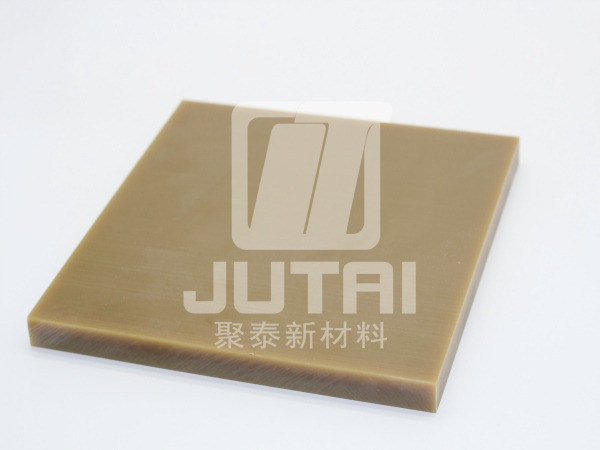
| JTYPEI® GF30 sheet is used for rigid fixture plates, structural supports, mounting plates and electrical insulating components that must resist deformation under mechanical load and repeated temperature changes. The 30% glass-fiber reinforcement provides higher stiffness and lower thermal expansion than natural PEI. JUTAI supplies cut plates and precision CNC-machined components according to customer drawings. For complete material properties and standard sheet sizes, refer to the JTYPEI® GF30 ULTEM™ 2300 PEI Sheet core product page. | |||||||||
High-load components do not fail because of material strength alone.
Long-term deformation, thermal expansion, fastener stress, stress concentration, component geometry and repeated temperature changes can also affect dimensional accuracy and service life.
JTYPEI® GF30 sheet is intended for flat or plate-shaped components requiring higher stiffness and better dimensional stability than natural unfilled PEI.
Typical parts include precision fixture plates, equipment supports, insulating mounting plates, sensor carriers, test jigs and structural components machined from sheet.
For this application, high load may include:
• Sustained static load
• Repeated mechanical loading
• Bending of unsupported plate sections
• Clamping force from bolts or fixtures
• Thermal expansion mismatch with metal components
• Repeated heating and cooling
• Vibration from industrial equipment
• Combined mechanical and electrical-insulation requirements
“High-load resistance” should not be interpreted as a universal load rating.
The actual allowable load must be determined according to component dimensions, support distance, operating temperature, load duration, fixing method, fiber orientation and the required safety factor.
The glass-fiber reinforcement increases stiffness and helps flat components resist bending under mechanical load.
This is useful for mounting plates, inspection fixtures, sensor bases and equipment supports that must maintain alignment.
PEI GF30 provides lower thermal expansion than natural PEI.
This can reduce dimensional movement when equipment repeatedly heats and cools or when plastic components are assembled with metal parts.
Fixture plates often contain locating holes, pockets, mounting surfaces and reference features.
The combination of higher stiffness, low moisture absorption and reduced thermal expansion helps maintain the relative position of these features.
Standard PEI GF30 is generally electrically insulating.
It can therefore be used for components that must provide mechanical support while electrically separating sensors, terminals, connectors or equipment assemblies.
Electrical suitability must be evaluated according to voltage, frequency, component thickness, creepage distance, clearance, temperature and moisture.
PEI GF30 can replace aluminum or other metals in selected components where reduced weight, corrosion resistance and electrical insulation are required.
Metal replacement must be supported by appropriate load, deflection, temperature and fastening calculations.
JTYPEI® GF30 sheet is particularly suitable for machining:
• Flat structural supports
• Mounting plates
• Precision fixture bases
• Inspection nests
• Sensor mounting plates
• Electrical insulating plates
• Terminal support plates
• Test-equipment fixtures
• Positioning jigs
• Lightweight equipment panels
• Thermal-cycling fixtures
• Semiconductor-equipment support plates
• Automation-system mounting components
• Components containing multiple drilled or milled features
Round bushings, sleeves, rings and cylindrical spacers should normally be produced from PEI GF30 rod rather than large sheets to reduce machining time and material waste.
detailed PEIGF30 sheet technical data sheet and 1~100mm thickness specification info, please refer to: JTYPEI® GF30 ULTEM™ 2300 PEI Sheet 5–100 mm
Application Requirement | PEI GF30 Suitability | Design Note |
|---|---|---|
High plate stiffness | Recommended | Verify span, thickness and load |
Low thermal movement | Recommended | Consider fiber orientation |
Electrical insulation | Generally suitable | Confirm voltage and thickness |
Precision fixture plate | Recommended | Use controlled machining sequence |
Metal replacement | Application dependent | Calculate load and deflection |
Repeated thermal cycling | Generally suitable | Evaluate fixing stress |
Severe impact loading | Requires caution | Natural PEI may provide better toughness |
High-speed dry sliding | Usually not preferred | Consider bearing-grade PEEK |
Strong-alkali exposure | Requires caution | Perform chemical compatibility testing |
Continuous service above 180°C | Requires evaluation | Consider PEEK or another higher-temperature material |
• Better impact toughness
• Easier machining
• Lower tool wear
• A smoother machined surface
• Natural translucent amber appearance
• Complex thin-wall features
• Balanced mechanical performance
• Higher stiffness
• Lower thermal expansion
• Better resistance to plate deflection
• Better dimensional stability under load
• Improved stability during thermal cycling
• A rigid structural or mounting plate
Material selection should be based on the complete combination of temperature, load, component geometry, electrical requirements and machining tolerances.
PEI natural sheet description: JTYPEI® NA ULTEM™ 1000 PEI Sheet 1–100 mm
• A higher continuous-use temperature is required
• Chemical exposure is more aggressive
• Hydrolysis or steam resistance is critical
• Higher fatigue resistance is required
• The application justifies the higher material cost
• High stiffness is required
• Chemical resistance is important
• Dimensional stability is required
• The component geometry and temperature are compatible with PPS
• Electrical and flame requirements can be met by the selected grade
PEI GF30 remains attractive when electrical insulation, inherent flame resistance, dimensional stability and machinability must be balanced at a lower material cost than PEEK.
Sharp internal corners and deep notches can produce high localized stress.
Use suitable radii and smooth transitions wherever possible.
Holes positioned too close to a sheet edge may reduce strength and increase the risk of cracking.
Fastener holes, locating holes and threaded features should have sufficient surrounding material.
Avoid over-tightened bolts, excessive interference fits and highly concentrated clamping loads.
Use washers, inserts, controlled torque or suitable clearances where required.
PEI GF30 and metal components have different thermal-expansion behavior.
Slot holes, floating fasteners or appropriate assembly clearance may be required in components exposed to temperature changes.
Glass-fiber-reinforced stock shapes may show directional differences in mechanical and thermal properties.
The machining layout and loading direction should be considered for critical structural components.
Plate thickness and support spacing should be selected according to the expected load and allowable deflection.
A thicker plate, additional support or redesigned geometry may be more effective than selecting material based only on tensile-strength data.
For high-precision fixture and structural plates:
Review the component drawing and loading direction.
Select a suitable sheet thickness with sufficient machining allowance.
Cut an oversized blank.
Rough-machine major pockets and surfaces.
Allow the component to stabilize or perform stress relief when required.
Finish-machine reference surfaces and critical holes.
Inspect the component at a controlled temperature.
Reconfirm dimensions after stabilization where very tight tolerances are required.
Carbide or PCD-coated tools are recommended because the glass fibers increase tool wear.
Stable support and evenly distributed clamping should be used to avoid plate deformation during machining.
PEI GF30 may not be the first choice when the application requires:
• Maximum impact toughness
• High-speed sliding performance
• Severe dry-running wear resistance
• Very low friction
• A translucent appearance
• Minimum machining-tool wear
• Strong-alkali resistance
• Resistance to chlorinated solvents
• Continuous temperatures substantially above approximately 180°C
• Electrical conductivity
• Implant-grade medical certification
Depending on the application, natural PEI, PEEK, bearing-grade PEEK, PPS, PPSU or another engineering plastic may be more suitable.
JUTAI provides:
• PEI GF30 full sheets
• Cut-to-size plates
• Material selection support
• Controlled annealing
• CNC milling
• Drilling and tapping
• Surface grinding
• Dimensional inspection
• Finished components according to drawings
• Worldwide delivery
For the complete technical data sheet, available thicknesses and standard sheet dimensions, please visit the JTYPEI® GF30 ULTEM™ 2300 PEI Sheet product page.
The internal link should be dofollow and should open in the same browser window.
Yes. PEI GF30 can be suitable for fixture plates and structural supports requiring high stiffness, low thermal movement and electrical insulation.
Final suitability depends on load, temperature, support spacing, fixing method and component geometry.
It can replace aluminum in selected applications where lower weight, corrosion resistance and electrical insulation are important.
Load capacity, stiffness, thermal expansion, fastening and dimensional tolerance must be evaluated before substitution.
PEI GF30 provides high stiffness and strength, but glass-fiber reinforcement may reduce impact toughness compared with natural unfilled PEI.
Natural PEI may be more suitable when impact loading or complex thin-wall geometry is the main concern.
Standard PEI GF30 is not automatically a bearing-grade material.
For severe sliding, dry-running or high-speed bearing applications, bearing-grade PEEK or another wear-modified material may be more appropriate.
Yes, but the achievable tolerance depends on plate dimensions, machining allowance, wall thickness, material removal, clamping method and inspection temperature.
Rough machining, stabilization and finish machining may be required for precision components.
The complete TDS, thickness range and standard dimensions are available on the JTYPEI® GF30 ULTEM™ 2300 PEI Sheet core product page.
Yes. JUTAI can review the drawing, load, temperature, tolerances, electrical requirements and chemical exposure before recommending PEI GF30 or an alternative material.
Please provide:
• Component drawing
• Finished dimensions
• Dimensional tolerances
• Mechanical load
• Load direction
• Operating temperature
• Support and fixing method
• Electrical requirements
• Chemical exposure
• Expected service life
• Quantity
• Required certificates
• Destination country
JUTAI will evaluate whether PEI GF30, natural PEI, PEEK GF30, PPS GF40 or another engineering plastic is more suitable.