
Views: 0 Author: Site Editor Publish Time: 2026-09-18 Origin: Site


Selecting the right high-performance thermoplastic for extreme thermal environments requires looking past baseline marketing claims. Engineers face tough challenges when designing components for severe heat. Premature material failure due to thermal degradation or loss of tensile strength leads to costly downtime and serious safety risks. Systems rely on predictable material behavior to function correctly under immense stress. We cannot afford unexpected part deformation in critical aerospace or medical applications.
This article provides a highly technical, evidence-based breakdown of how temperature shifts impact the mechanical and structural integrity of a PEEK rod. You will learn to precisely evaluate foundational thermal limits. We explore how crossing key thresholds alters tensile strength and stiffness. The guide also helps you evaluate different grades and recognize critical implementation risks before they cause system failures.
A standard PEEK rod maintains exceptional mechanical stability up to its Continuous Use Temperature (CUT) of 260°C (500°F).
Crossing the Glass Transition Temperature (Tg) at 143°C (289°F) fundamentally alters tensile strength and stiffness, requiring specific grade evaluations.
Unfilled (peek natural rod) and reinforced grades exhibit drastically different thermal expansion and wear profiles under high heat.
Successful implementation relies on verifying exact PEEK rod specifications and ensuring proper annealing from a qualified PEEK rod supplier.
Understanding polyetheretherketone (PEEK) requires mapping its exact thermal profile. You cannot simply look at a maximum temperature rating. Engineers must evaluate how the polymer behaves across different thermal states. The material features both amorphous and crystalline regions. They react differently as ambient heat rises. We rely on three foundational limits to predict performance for a standard peek rod.
The Glass Transition Temperature (Tg) sits at 143°C (289°F). Reaching this point causes the amorphous regions of the polymer to soften. The material shifts from a rigid, glassy state into a more flexible, rubber-like state. It does not melt, but its mechanical properties change drastically. Rigidity drops, and the polymer becomes far more susceptible to deformation under load.
The Continuous Use Temperature (CUT) is 260°C (500°F). This represents the maximum baseline temperature for sustained operation. You can operate parts at this heat for thousands of hours without permanent thermal degradation. The polymer matrix remains chemically stable here. However, components must be designed for the softened state they enter past Tg.
The Melting Point (Tm) occurs at 343°C (649°F). Reaching this threshold guarantees total structural failure. The crystalline matrix breaks down completely. The polymer liquefies, losing all shape and load-bearing capacity.
Table 1: Foundational Thermal Limits of Standard PEEK
Thermal Threshold | Temperature (°C / °F) | Material State & Impact |
|---|---|---|
Glass Transition (Tg) | 143°C / 289°F | Amorphous regions soften. Sudden drop in stiffness and tensile strength. |
Continuous Use (CUT) | 260°C / 500°F | Maximum safe limit for long-term thermal exposure. No chemical breakdown. |
Melting Point (Tm) | 343°C / 649°F | Crystalline structure fails. Total liquefaction and structural collapse. |
We must strictly distinguish between standard operational limits and extreme peak exposures. Short-term thermal loads can briefly push past the CUT. Brief spikes up to 300°C might not destroy the part. However, long-term thermal loads demand strict adherence to the 260°C ceiling. Exceeding continuous limits accelerates failure.
Thermal environments aggressively test mechanical integrity. Tensile strength does not degrade in a smooth, linear fashion. You see a dramatic cliff once the ambient or frictional temperature crosses the Tg threshold. At room temperature, standard unfilled PEEK boasts a robust tensile strength near 100 MPa. When it hits 143°C, the amorphous chains unlock. Tensile strength drops rapidly. The flexural modulus plummets. Engineers must account for this non-linear drop when designing load-bearing structural components.
Dimensional stability and creep resistance also suffer under continuous high-temperature stress. Creep refers to the slow, permanent deformation of a solid material under mechanical loads. As heat increases, thermal expansion rates shift. The polymer swells slightly. Tight-tolerance machined parts can easily lose their precise fits. A bearing might seize on a shaft. A seal might lose its tight compression. You must factor in elevated thermal expansion coefficients when calculating clearances for hot environments.
Frictional wear compounds these issues significantly. High-speed rotational or sliding applications generate severe localized heat. A rapidly spinning bushing creates friction. This friction acts as a secondary heat source. It stacks on top of the environmental temperature. The localized surface temperature can easily exceed the material's limits, even if the room is cool. This compounding heat accelerates material fatigue. The surface softens, leading to rapid galling and premature mechanical wear.
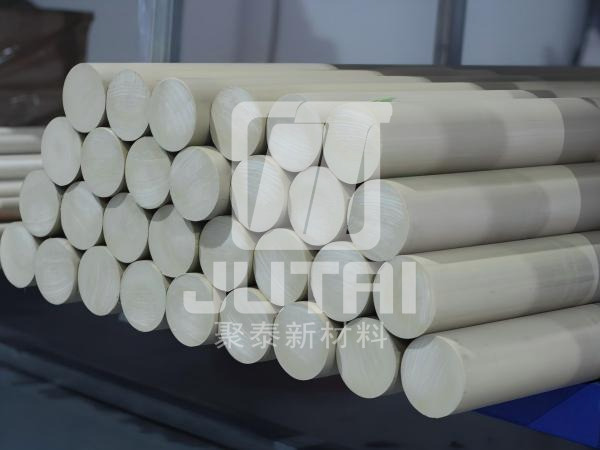
Every extreme environment demands a highly tailored material choice. We cannot treat all polyetheretherketone grades identically. Unfilled grades and reinforced grades perform very differently under severe heat. Careful evaluation ensures you select the correct polymer blend.
Evaluating a peek natural rod starts with its baseline thermal performance. Unfilled PEEK delivers maximum elongation and toughness. It provides exceptional high-purity characteristics. This makes it a primary choice for medical devices, food processing, and semiconductor manufacturing. It meets stringent FDA and compliance regulations easily. However, unfilled PEEK struggles to hold high structural loads once temperatures exceed 150°C. Its heat deflection capabilities remain relatively low compared to filled variants.
Reinforced grades change the equation entirely. Adding carbon fiber or glass fiber stiffens the polymer matrix. These fillers act as a structural skeleton. They elevate the Heat Deflection Temperature (HDT) dramatically. While standard unfilled resin deflects around 152°C, a 30% carbon-filled grade can maintain structural rigidity up to 315°C under the same load. They maintain their stiffness well beyond standard Tg limits.
Chart 1: Heat Deflection Temperature (HDT) Comparison Summary
Material Grade | Reinforcement Type | Approximate HDT (at 1.8 MPa) | Primary Thermal Benefit |
|---|---|---|---|
Unfilled Natural | None | 152°C (305°F) | High purity, toughness, maximum ductility. |
Glass-Filled (30%) | Glass Fibers | 315°C (599°F) | Excellent thermal insulation, high stiffness. |
Carbon-Filled (30%) | Carbon Fibers | 315°C (599°F) | Maximum compressive strength, high wear resistance. |
To ensure success, engineers should utilize a structured decision framework. You must match specific mechanical demands with precise material requirements. Review exact PEEK rod specifications before finalizing a design.
Define Maximum Temperature: Determine both the continuous operating temperature and extreme peak exposure limits.
Calculate Structural Loads: Assess whether the part will bear heavy compressive or tensile loads while heated.
Select the Grade: Choose unfilled grades for purity and ductility, or select carbon/glass-filled grades for maximum rigidity above 150°C.
Evaluate Chemical Exposure: Verify if elevated heat will catalyze aggressive chemical reactions in your specific operating environment.
Determine Dimensions: Specify the exact rod diameter needed to yield the final machined part without excessive material waste.
Even elite thermoplastics fail when engineers ignore their physical limits. Understanding implementation risks prevents catastrophic system breakdowns. Thermal aging and embrittlement represent a severe threat. Prolonged exposure to temperatures slightly above 260°C degrades the polymer slowly. The material undergoes oxidation over thousands of hours. The plastic loses its toughness. It becomes brittle. A sudden load or impact will cause sudden brittle failure rather than bending or yielding.
Chemical vulnerabilities also escalate at high heat. PEEK is famously chemically inert at room temperature. It withstands harsh solvents and hydrocarbons easily. However, elevated temperatures act as a potent catalyst. Heat dramatically reduces the polymer's resistance to specific concentrated acids. Hot sulfuric acid or hot nitric acid will aggressively attack the polymer chains. You must re-test chemical compatibility if your operating temperature rises.
Machining stress presents another massive hidden risk. Extruding plastics creates significant internal stress. Improperly annealed rods hold this tension inside their core. When a machine shop cuts into an un-annealed rod, those stresses remain trapped. Once that machined part sees operational heat in the field, the internal stresses violently release. The part will warp, twist, or crack completely. Dimensional stability disappears. Only proper heat treatment during manufacturing prevents this warpage.
The quality of your raw material dictates the success of your machined part. Procurement strategies matter deeply. You must rigorously evaluate your manufacturing partners. The extrusion process requires extreme precision and care.
The role of annealing cannot be overstated. Suppliers must provide fully stress-relieved rods. Proper annealing involves slowly heating and cooling the extruded rod in highly controlled ovens. This process relaxes the polymer chains. It locks in dimensional stability. If your partner skips this step to save time, your parts will deform in hot environments. You should demand proof of their annealing cycles.
Traceability and batch consistency provide crucial safety nets. High-stakes applications demand material certifications. You need lot traceability back to the original resin batch. Excellent suppliers verify their raw resin sources. They utilize premium base polymers from established brands like Victrex™ or Evonik. Mixing inferior or recycled resins severely compromises thermal stability.
When shortlisting a potential PEEK rod supplier, ask specific, technical questions to verify their expertise:
Do you perform comprehensive ultrasonic void-detection testing on thick-diameter rods to ensure solid cores?
Can you provide full material test reports (MTRs) and certificates of compliance for every batch?
What specific temperature ramp-up and cool-down cycles do you use during your annealing process?
Do you source 100% virgin resin, or is regrind material introduced during extrusion?
Are your manufacturing facilities certified to ISO 9001 or equivalent quality management standards?
Mastering thermal environments requires a deep understanding of polymer physics. PEEK stands as a top-tier thermal performer, but only when engineers respect its structural shifts. You must plan for the mechanical changes that occur at the Glass Transition Temperature (Tg). You must strictly enforce the Continuous Use Temperature (CUT) limits. Leveraging filled grades allows you to maintain critical stiffness in scorching environments, while unfilled grades offer unmatched purity and toughness.
The best designs fail if the raw material lacks quality or proper stress relief. We recommend consulting directly with technical sales teams to discuss your exact application. Take the time to match specific load, temperature, and chemical exposure requirements to exact material specifications. A meticulous sourcing strategy guarantees your high-performance components survive their demanding operational lives.
A: A standard rod can typically withstand brief, short-term exposures up to 300°C (572°F). However, structural integrity drops significantly at this heat. The material softens severely. You must remove all mechanical loads during these brief exposure spikes to prevent immediate, permanent deformation or part failure.
A: The difference is substantial. A natural, unfilled rod has an HDT of approximately 152°C (305°F) under a 1.8 MPa load. A 30% carbon-filled rod elevates that HDT to 315°C (599°F). Reinforcement prevents the polymer from bending and yielding at much higher operational temperatures.
A: Yes, it frequently replaces aluminum and stainless steel in 250°C environments. It offers an exceptional strength-to-weight ratio, weighing about 70% less than standard metal alloys. It resists corrosion entirely. However, replacing metal requires specific design modifications, like thicker wall sections, to compensate for lower overall flexural modulus.


