
Views: 0 Author: Site Editor Publish Time: 2026-08-12 Origin: Site


Specifying materials for high-temperature fluid handling or sterilization environments is tough. Engineers often face a difficult choice. You either overpay for extreme-grade polymers like PEEK, or you risk premature failure using standard polycarbonates. This is where a PSU plastic sheet steps in. Polysulfone offers a pragmatic, middle-tier solution. It handles continuous 150°C (300°F) operating environments reliably. It delivers structural rigidity, hydrolytic stability, and excellent visual transparency.
However, we must be realistic about material limits. While highly capable, improper machining practices will damage it quickly. Using petroleum coolants ruins the material integrity. Exposing it to specific solvents like ketones causes rapid environmental stress cracking (ESC). In this guide, we will explore how to successfully specify and machine polysulfone. You will learn its thermal baselines, chemical compatibilities, and critical design guidelines. This knowledge will help you ensure your next high-temperature project succeeds.
Thermal & Hydrolysis Baseline: Maintains rigidity and extreme dimensional stability (<0.1% change) in continuous 150°C water/steam.
Chemical Sweet Spot: Exceptional resistance to pH 2–13, bleach, and oxidizing agents, but highly sensitive to aromatic hydrocarbons and ketones.
Cost-to-Performance: Offers a highly economical alternative to PEEK ($60–$80/kg tier) while significantly outperforming PC and Acrylic in thermal metrics.
DFM Criticality: Machining requires mandatory pre-annealing, strict avoidance of sharp internal corners (notch sensitivity), and specific non-aromatic coolants.
Engineers must carefully map out the cost-versus-performance landscape. The high-temperature polymer pyramid helps clarify these boundaries. Choosing the wrong tier leads to either catastrophic part failure or wasted budget.
Over-engineered Tier: PEEK sits at the top of the pyramid. It is ideal for 250°C+ aerospace environments or internal body implants. However, it remains highly cost-prohibitive for large volume manufacturing runs.
Balanced Tier: A polysulfone sheet hits the engineering sweet spot. It serves ideally for 150°C–160°C applications. It provides essential transparency and budget efficiency. It generally costs roughly one-third the price of extreme-grade PEEK.
Commodity Tier: Polycarbonate (PC) and Acrylic sit at the bottom. They are cheap but melt or degrade quickly in pressurized steam.
You must also understand the difference between PSU and PPSU (Polyphenylsulfone). This bottom-of-funnel distinction trips up many procurement teams. We specify PSU for standard hot-water manifolds and occasional sterilization needs. You should upgrade to PPSU only if your application requires thousands of repeated, high-stress steam autoclave cycles. PPSU offers extreme impact resistance, but it costs significantly more. PSU balances these factors perfectly for most industrial fluid systems. It delivers the performance you need without draining project funds.
You must verify specific performance benchmarks before selecting a high temperature PSU plastic. Thermal metrics dictate where this material can survive safely.
Two critical benchmarks define its thermal capabilities. First, it boasts a Glass Transition Temperature (Tg) of 185°C. Second, its Heat Deflection Temperature (HDT) reaches roughly 345°F at 264 psi. These numbers mean the plastic remains physically rigid long after standard polymers soften and warp.
Material Grade | Continuous Use Temp | Heat Deflection (264 psi) | Steam Tolerance |
|---|---|---|---|
Standard Polycarbonate (PC) | 115°C (239°F) | 270°F | Poor (Degrades) |
Polysulfone (PSU) | 150°C (300°F) | 345°F | Excellent |
PEEK | 250°C (480°F) | 300°F (Unfilled) | Exceptional |
We must also define what makes it a true hydrolysis resistant PSU. Hydrolysis refers to chemical breakdown caused by water exposure. Standard plastics absorb water, swell, and lose mechanical integrity. PSU simply will not degrade in continuous boiling water. It maintains its dimensions perfectly.
However, we must address the autoclave caveat. Industry standards label PSU as autoclavable. Yet, you cannot ignore mechanical reality. Compounding high mechanical stress with repeated high-pressure steam sterilization cycles induces material fatigue over time. Micro-cracking will eventually occur if you push the boundaries too far. You should treat PSU as a robust solution for periodic sterilization, not endless high-stress medical cycling.
Knowing exactly where a chemical resistant PSU material thrives is critical for long-term reliability. We can divide its chemical compatibility profile into clear safe and danger zones. This helps prevent costly field failures.
The "Green Light" environments highlight where this polymer dominates. The material remains highly stable around common sterilizers. It is fully compatible with 5% hydrogen peroxide and standard bleach. It handles industrial surfactants easily. Furthermore, you can expose it continuously to inorganic acids and bases ranging from pH 2 to 13. This broad alkaline and acid resistance sets it apart from sensitive acrylics.
Chemical Exposure | Compatibility Status | Typical Reaction |
|---|---|---|
Bleach & Hydrogen Peroxide | Safe | No degradation; maintains clarity. |
Inorganic Acids (pH 2-13) | Safe | Highly stable continuous exposure. |
Ketones (Acetone) | Danger | Severe stress cracking; dissolves. |
Aromatic Hydrocarbons (Toluene) | Danger | Rapid embrittlement and structural failure. |
The "Red Light" environments demand strict risk mitigation. We constantly warn engineers to avoid specific chemical families. PSU will dissolve or experience severe environmental stress cracking (ESC) around ketones, like acetone. It fails rapidly around esters, benzene, toluene, and certain aromatic hydrocarbons. You must review safety data sheets for all cleaning agents used near the final assembly.
This unique chemical profile dictates its real-world applications. It makes PSU perfect for medical fluid manifolds and food-grade processing valves. It excels in chemical pump inspection windows. In these scenarios, you need visual clarity combined with strong alkaline resistance.
Design for Manufacturability (DFM) is non-negotiable when cutting amorphous plastics. If you treat polysulfone like aluminum, the parts will crack before they leave the machine shop.
Avoid Notch Sensitivity: This represents the most critical design flaw. Amorphous plastics like PSU are highly notch sensitive. Sharp internal corners concentrate mechanical stress dangerously. You must specify generous radiused corners for all machined parts. Eliminate sharp right angles completely.
Follow Annealing Requirements: You must manage internal stresses. Detail the necessity of stress-relieving the material before machining. Sometimes, you must anneal it again after heavy material removal. Proper thermal cycling prevents latent cracking from manifesting weeks later.
Enforce Coolant Restrictions: Shop-floor guidance must be explicit. You must strictly prohibit petroleum-based coolants during CNC machining. Petroleum instantly attacks the polymer chains. Mandate compressed air instead. If you require liquid cooling, use a non-aromatic, water-soluble mist.
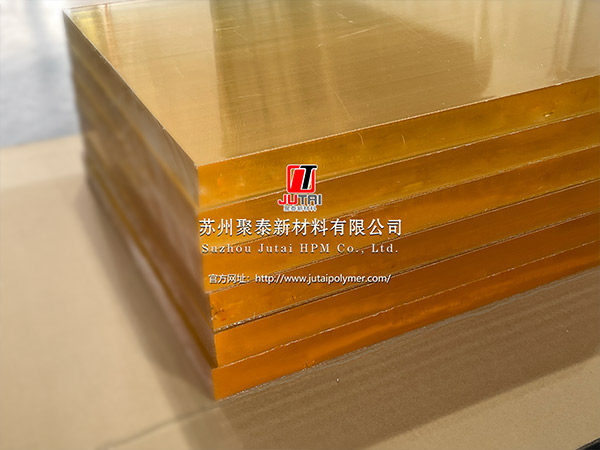
Plan for Restoring Transparency: Machining a translucent, amber PSU natural sheet leaves a frosted, opaque finish. The cutting tool creates microscopic scratches. You must specify vapor polishing or solvent polishing as a secondary operation. This step restores necessary optical clarity for oil level indicators or fluid sight glasses.
Ignoring these DFM rules guarantees poor yields. Best practices involve close communication between the engineering team and the CNC programmers. Ensure everyone understands the coolant restrictions before the first chip flies.
You must match the specific material grade to your application demands. Manufacturers modify base resins to achieve different mechanical properties.
Unfilled natural PSU serves as the baseline workhorse. This specific grade is best for applications requiring strict FDA compliance. It offers helpful semi-transparency and strong baseline thermal resistance. Engineers frequently specify unfilled grades for microwaveable commercial components. It performs brilliantly in reusable medical trays and complex fluid handling sight glasses. Because it lacks additives, it retains maximum visual clarity and chemical purity.
However, demanding mechanical environments require modified grades. Glass-fiber and carbon-fiber reinforced options change the physical properties entirely. Adding 20-30% glass fiber restricts transparency completely. The material turns opaque and rigid. Yet, this addition dramatically boosts tensile strength well beyond the baseline 10,200 psi. It increases structural stiffness significantly. You should specify these reinforced grades for load-bearing electrical connectors. They also perform perfectly as structural pump housings where preventing physical creep under high pressure is mandatory.
Selecting the right high-temperature polymer requires logical evaluation. Let us summarize the shortlisting logic. If your project requires operating temperatures up to 160°C, polysulfone makes perfect sense. It offers strict dimensional stability in hot water. It provides necessary visual clarity for fluid monitoring. As long as you exclude harsh aromatic solvents and ketones from the environment, it remains the optimal specification.
You can take actionable next steps today. Guide your procurement team to request comprehensive material datasheets. Ask your supplier for specific chemical compatibility matrices. Most importantly, order sample blocks for prototype machining. Testing the material in your own CNC machines validates your DFM approach and ensures your final assemblies will perform flawlessly in the field.
A: The main disadvantages include high notch sensitivity, which requires generous radiused corners in designs. It also suffers from susceptibility to UV degradation, making it unsuitable for long-term outdoor exposure. Finally, it exhibits severe vulnerability to environmental stress cracking when exposed to esters, aromatic hydrocarbons, and ketones.
A: Yes. Where polycarbonate fails structurally around 120°C or degrades via hydrolysis in steam, polysulfone survives continuous exposure up to 160°C. However, PSU has lower impact strength than PC and requires far more careful machining to prevent latent cracking.
A: Yes. Unfilled natural polysulfone is generally FDA-compliant for direct food contact. It easily handles the high-temperature, aggressive chemical washdowns common in commercial bottling and food packaging lines without losing dimensional stability.


