
Views: 0 Author: Site Editor Publish Time: 2026-10-11 Origin: Site


Engineers and procurement teams face a tough material selection challenge daily. You must balance extreme performance demands against strict project budgets. Choosing the right high-performance polymer is rarely simple. Teams often struggle when deciding between Polyetherimide (PEI) and Polyetheretherketone (PEEK). Over-speccing to PEEK wastes vital capital. Conversely, under-speccing to PEI risks catastrophic part failure in highly aggressive environments. Making the wrong choice leads to severe project delays and blown budgets. You need a reliable method to navigate this decision. Our goal is to provide a clear, evidence-based evaluation framework. We will help you determine exactly when a PEI polymer suffices for your application. You will also discover when upgrading to a premium PEEK material becomes a mandatory investment for long-term safety.
Engineers frequently compare these two polymers because they sit at the pinnacle of the high-performance plastics pyramid. They share several critical characteristics that make them top choices for demanding environments. PEI operates as an amorphous thermoplastic. PEEK functions as a semi-crystalline thermoplastic. Despite this structural difference at the molecular level, both materials deliver exceptionally high mechanical strength. They boast inherent flame retardancy. Both easily achieve V-0 flammability ratings without requiring any toxic or halogenated additives. They also produce extremely low smoke emission during combustion.
You will find both materials operating in similar demanding industrial sectors. Aerospace engineers use them heavily for structural brackets, aircraft interiors, and complex cable insulations. Medical device manufacturers rely on them for reusable surgical instruments. These instruments must survive repeated steam sterilization without degrading. Semiconductor fabrication plants use both plastics for critical wafer-handling components and testing nests.
We must establish exactly where these materials diverge to make an informed choice. The PEI vs PEEK decision ultimately hinges on three core factors. You must rigorously evaluate your peak operating temperature, exact chemical exposure, and budget tolerance. Understanding these boundaries prevents costly engineering mistakes and ensures optimal part performance.
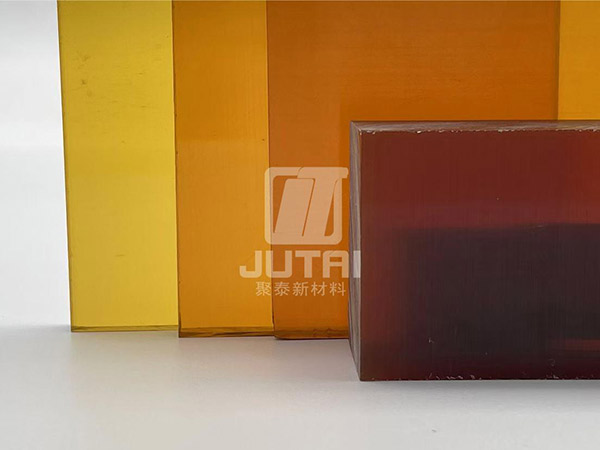
Heat often dictates your final material selection. We evaluate thermal capabilities primarily using the Continuous Use Temperature (CUT) metric. PEI delivers reliable, long-term performance up to 170°C (340°F). This impressive thermal limit safely covers most automotive under-hood components, electronic insulators, and standard industrial applications. PEEK, however, thrives in extreme heat. It maintains structural integrity continuously up to 250°C (480°F). Deep-hole drilling operations and aerospace engine components heavily rely on this higher threshold.
Glass Transition (Tg) and melting points heavily impact dimensional stability. They dictate creep resistance when parts face physical load in hot environments. PEI features a Tg of approximately 217°C. Because it is amorphous, it lacks a true melting point. It softens gradually as heat increases beyond its Tg. PEEK behaves very differently. It has a lower Tg around 143°C. However, it boasts a massively high melting point of 343°C. Its semi-crystalline structure allows it to bear significant physical loads even above its Tg. This crystallinity gives PEEK superior creep resistance in high-heat environments.
Both plastics offer incredible mechanical strength. Unfilled PEEK usually provides a tensile strength near 100 MPa. PEI closely follows at roughly 105 MPa. At room temperature, PEI actually behaves somewhat stiffer than PEEK. However, as operating temperatures rise, PEEK retains its mechanical properties far better. It survives physical loads at elevated temperatures where PEI would quickly deform.
Table 1: Thermal and Mechanical Property Comparison
| Property | Polyetherimide (PEI) | Polyetheretherketone (PEEK) |
|---|---|---|
| Tensile Strength | ~105 MPa | ~100 MPa |
| Continuous Use Temp (CUT) | 170°C (340°F) | 250°C (480°F) |
| Glass Transition Temp (Tg) | 217°C (422°F) | 143°C (289°F) |
| Melting Point (Tm) | N/A (Amorphous) | 343°C (649°F) |
A material might survive intense heat, but aggressive chemicals can destroy it rapidly. Chemical resistance is where these polymers distinctly separate. You must evaluate the operating environment closely.
PEI features a strong chemical profile. It strongly resists most aqueous solutions, alcohols, and hydrocarbons. It handles automotive fluids and mild acids beautifully. However, you must watch out for its chemical weaknesses. PEI is partially soluble in halogenated solvents. It is also highly susceptible to environmental stress cracking in strong alkaline environments. You cannot expose PEI to strong bases like sodium hydroxide for extended periods. It will become brittle and crack under load.
PEEK offers superior, near-universal chemical defense. Its semi-crystalline nature acts as a highly dense barrier against aggressive molecules. PEEK resists organic solvents, harsh bases, and acids perfectly. It maintains this extreme resistance even at elevated temperatures. The only major exceptions are concentrated sulfuric and concentrated nitric acids. If your environment involves highly reactive chemicals, PEEK rarely fails.
We advise buyers to follow a strict evaluation framework before selecting a material:
Never rule out a PEI sheet before mapping these exposures thoroughly. If the chemical environment is relatively mild, PEI performs perfectly well and saves substantial capital.
Engineers must consider how easily a material transitions from raw stock to a finished part. Machining high-performance plastics requires deep expertise. Tooling wear differs significantly between these two polymers. Unfilled PEI is generally easier to machine. It is much gentler on cutting tools, allowing for longer production runs without tool replacement.
Conversely, PEEK is highly abrasive. This abrasive nature amplifies greatly if you use glass-filled or carbon-filled grades. Machining filled PEEK requires sharp carbide or diamond-tipped tooling. Standard high-speed steel tools will dull rapidly. Dull tools generate excess friction. This friction melts the plastic, ruins surface finishes, and induces severe internal stress.
Internal stress and annealing present massive manufacturing challenges. You must follow strict annealing schedules. Machining a PEEK sheet without proper stress-relieving cycles guarantees failure. The material will warp, crack, and fall completely out of tolerance. The same strict rule applies to PEI. Machinists must heat the materials slowly, hold them at specific elevated temperatures, and cool them gradually in a controlled oven.
Dimensional stability relies heavily on moisture absorption. Both polymers remain exceptionally stable compared to nylon or acetal. However, PEI absorbs slightly more ambient moisture than PEEK. If your application demands extreme micro-tolerances for semiconductor or aerospace components, you must account for this absorption difference. PEEK maintains its dimensional stability perfectly even in high-humidity or submerged environments.
We must acknowledge the commercial reality of high-performance plastics. PEEK is undeniably a premium material. It often costs 300% to 500% more than PEI by weight or volume. This massive price gap dictates strategic purchasing decisions.
Engineers often fall into the "over-speccing" trap. They default to PEEK simply "just to be safe." This mindset drains project budgets quickly. If your application never exceeds 150°C, you do not need PEEK's extreme heat defense. If the part sees only mild chemical exposure, paying for PEEK represents a negative-ROI decision. You must match the material precisely to the exact environmental requirements.
Use this shortlisting logic to guide your decision:
Regulated industries require specific material certifications. Both materials excel in compliance, but they behave differently under extreme validation testing.
In the medical sector, biocompatibility is absolutely paramount. Both polymers easily pass stringent USP Class VI testing. They safely handle repeated steam autoclaving. However, PEEK offers superior longevity. It withstands thousands of intense autoclave cycles without degrading or losing mechanical strength. PEI handles autoclaving well, but its structural lifespan is shorter under constant, daily sterilization.
Aerospace applications demand rigorous safety checks. Both materials meet strict Federal Aviation Administration (FAR 25.853) requirements. They pass rigorous flammability, smoke, and toxicity (FST) standards. During vertical burn tests, both materials self-extinguish rapidly. This vital property makes them ideal for cabin interiors, overhead bins, and air ventilation systems.
For food processing applications, both polymers offer FDA-compliant grades. They safely contact food products without leaching harmful chemicals. Always verify your specific raw material lot carries the necessary compliance certificates before beginning fabrication.
The debate between these high-performance plastics has a clear resolution. You solve the material selection challenge by carefully matching exact environmental thresholds to your budget. PEEK provides unmatched thermal and chemical defense at a premium price. PEI delivers outstanding performance for moderate-to-high heat environments at a mere fraction of the cost.
Your next steps involve strict validation. We encourage buyers to request detailed material data sheets (TDS) directly from manufacturers. Order sample sheets for prototyping, machining trials, and physical testing. Consult directly with a material engineer to verify your exact specifications. Proper verification ensures you commit to bulk procurement with absolute confidence.
A: Only if the application's demands fall entirely within PEI's lower threshold limits. You cannot substitute PEI into a PEEK-required environment without risking failure.
A: Unfilled PEI is generally easier to machine and gentler on tooling than PEEK, but both require sharp carbide/diamond tooling and careful heat management.
A: Yes. To achieve tight tolerances and prevent warping, stress-relieving through precise heating cycles is critical for both materials.


