
Views: 0 Author: Site Editor Publish Time: 2026-04-13 Origin: Site


Selecting the right tubing material has become more important than ever in industries where performance, consistency, and service life directly affect product quality and operating cost. Engineers, buyers, and product developers are no longer choosing materials based only on availability or tradition. They are evaluating how a material behaves under heat, pressure, chemical exposure, friction, sterilization, and long-term mechanical stress. In that context, PEEK Tube has gained increasing attention as a high-performance solution that can overcome many of the limitations associated with metal tubing and standard polymer tubing. Compared with stainless steel, aluminum, PTFE, PVC, nylon, and other engineering plastics, PEEK offers a more balanced combination of strength, thermal stability, dimensional precision, wear resistance, and chemical durability.
PEEK, or polyether ether ketone, is known as a high-performance thermoplastic used in demanding industrial and technical environments. When manufactured into tubing form, it becomes especially useful in systems that require both structural integrity and design flexibility.
What makes PEEK Tube stand out is that it sits in a unique middle ground. It is lighter than metal, yet much stronger and more heat-resistant than many common polymers. This gives engineers more room to optimize equipment, especially where space, weight, corrosion, and thermal loading all matter at the same time.
In recent years, more industries have started replacing conventional materials with PEEK Tube in order to improve:
· product lifespan
· equipment reliability
· chemical compatibility
· weight reduction
· maintenance efficiency
This shift is not driven by trend alone. It is driven by performance needs that standard materials cannot always meet.
A direct comparison helps explain why PEEK Tube is increasingly chosen for advanced applications.
Property | PEEK Tube | Metal Tubing | Standard Polymer Tubing |
Weight | Very lightweight | Heavy | Lightweight |
Mechanical strength | High | Very high | Low to medium |
Corrosion resistance | Excellent | Can corrode | Usually good |
Chemical resistance | Excellent | Varies by metal | Varies widely |
Heat resistance | Excellent | Good to excellent | Usually limited |
Electrical insulation | Excellent | Poor | Good |
Wear resistance | Very good | Good | Usually moderate |
Dimensional stability | High | High | Can deform more easily |
Machinability / customization | Good | Moderate to difficult | Good |
Long-term performance | Excellent | Good | Often limited |
The table makes one thing clear: PEEK Tube combines advantages from both sides. It offers many of the toughness and structural benefits associated with metal, while also delivering the corrosion resistance, lower weight, and electrical insulation associated with polymers. Few other materials perform so well across such a broad set of requirements.
One of the biggest reasons companies move away from metal is weight. One of the biggest reasons they avoid common plastics is weak mechanical performance. PEEK Tube helps solve both problems at once.
Metal tubing is undeniably strong, but it adds mass to assemblies, increases transportation burden, and may complicate installation in precision systems. Standard polymers are light, but many cannot maintain shape or strength when exposed to load, vibration, or elevated temperature. PEEK Tube offers a more efficient balance.
In many applications, reducing weight is not just about convenience. It improves the full system:
· in aerospace, lighter parts support fuel efficiency
· in medical devices, lighter components improve handling and precision
· in electronics, compact and light structures reduce design constraints
· in automation systems, lower moving mass improves response and reduces wear
PEEK retains excellent tensile and flexural properties, even under repeated stress. It also has strong creep resistance, which means it is less likely to deform permanently over time under load. This is especially useful in fluid transfer systems, instrumentation, and high-precision assemblies where dimensional stability matters.
In short, PEEK Tube provides strength without the traditional weight penalty of metal.
Corrosion is one of the most expensive hidden problems in industrial design. Metal tubing may look strong at first, but when it is placed in chemically active environments, moisture-rich conditions, or systems involving cleaning agents and process fluids, its weakness becomes more visible over time.
PEEK Tube avoids many of these issues because it is inherently resistant to a wide range of aggressive substances. It performs well when exposed to:
· acids
· bases
· organic solvents
· fuels
· oils
· sterilization chemicals
· cleaning media used in industrial processing
This chemical stability is one of the reasons PEEK Tube is often selected for analytical instruments, semiconductor processing, chemical handling systems, and medical environments. By resisting degradation, swelling, and surface breakdown, it can help extend equipment life and reduce unplanned maintenance.
Temperature capability is another area where PEEK Tube benefits compared to metal and other polymers become especially clear. Many plastics perform acceptably at room temperature, but once heat rises, their limitations quickly appear. They may soften, creep, warp, or lose structural reliability.
PEEK is different. It maintains excellent mechanical and dimensional performance across a wide temperature range and remains suitable for continuous service in environments that would challenge many engineering plastics.
Materials such as PVC, polypropylene, and nylon may be suitable for general-purpose tubing, but they are often not ideal for sustained high-temperature use. PTFE has excellent chemical resistance, but in some applications it lacks the rigidity and load-bearing performance needed for more structural functions.
PEEK Tube offers a stronger combination of:
· heat resistance
· stiffness
· wear performance
· mechanical retention under thermal stress
Metal performs well under heat in many situations, but it can introduce other concerns:
· thermal conductivity can be undesirable in sensitive systems
· heat expansion may affect precision assemblies
· added insulation may be required in electrical or thermal management applications
· corrosion risk often increases at elevated temperatures in harsh media
Because PEEK Tube provides both heat resistance and insulation, it opens new options in applications where designers need more than simple temperature survival. They need thermal control.
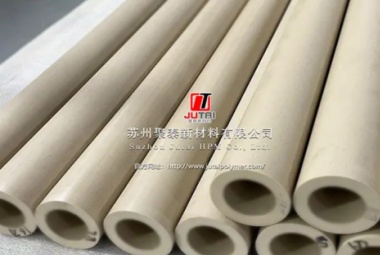
Unlike metal tubing, PEEK Tube is an excellent electrical insulator. This is a decisive advantage in systems where conductivity creates risk, interference, or additional design burden.
Electrical insulation matters in:
· electronics manufacturing
· battery systems
· telecommunications equipment
· precision sensors
· semiconductor tools
· medical devices
If metal tubing is used in such environments, designers may need separate insulating layers, protective housings, or more complex assembly methods. PEEK Tube can simplify that equation.
Not all tubing applications are static. Some systems involve movement, friction, pulsing pressure, repeated contact, or abrasive media. In such conditions, the ability of a material to resist wear becomes a major factor in long-term cost.
PEEK Tube performs well in applications where durability matters over repeated cycles. It shows good resistance to abrasion and surface wear, especially when compared with many conventional plastics. This helps maintain the internal and external integrity of the tube during prolonged operation.
A longer service life can create practical value in several ways:
· fewer replacement intervals
· reduced maintenance downtime
· lower total operating cost
· more stable process performance
· improved confidence in critical applications
While metal can also offer strong wear performance, it may do so at the expense of weight, corrosion complexity, or machining difficulty. Meanwhile, softer polymers may wear too quickly under load or contact. PEEK Tube often delivers a better long-term balance.
Material selection should always begin with the actual demands of the application rather than habit or initial price alone. From our perspective, the strongest reason to consider PEEK Tube is not that it replaces every traditional material, but that it performs exceptionally well when multiple demands come together in one design: strength, heat, chemical exposure, wear resistance, low weight, and long-term consistency. That is why more engineers and manufacturers continue to move toward it in advanced industrial systems. At Suzhou Jutai HPM Co., Ltd., we see this shift clearly in the needs of customers looking for dependable high-performance tubing solutions rather than one-size-fits-all materials. If you are reviewing options for a current or future project, we believe it is worth taking a closer look at how PEEK Tube may fit your technical goals, and you are welcome to contact Suzhou Jutai HPM Co., Ltd. for further information and product discussion.
PEEK Tube offers a higher level of heat resistance, mechanical strength, dimensional stability, and wear resistance than many standard polymers such as PVC, nylon, or polypropylene. This makes it more suitable for demanding industrial applications.
Not in every case. Metal may still be preferred in some extremely high-load or highly specialized structural applications. However, PEEK Tube is often a better option when lower weight, corrosion resistance, chemical stability, and electrical insulation are important.
PEEK Tube is widely used in medical equipment, aerospace components, electronics, semiconductor processing, automotive systems, and industrial fluid handling where material performance is critical.
Not necessarily. Although the purchase price is higher, PEEK Tube can reduce long-term cost through extended service life, lower maintenance frequency, improved reliability, and reduced system downtime.


